
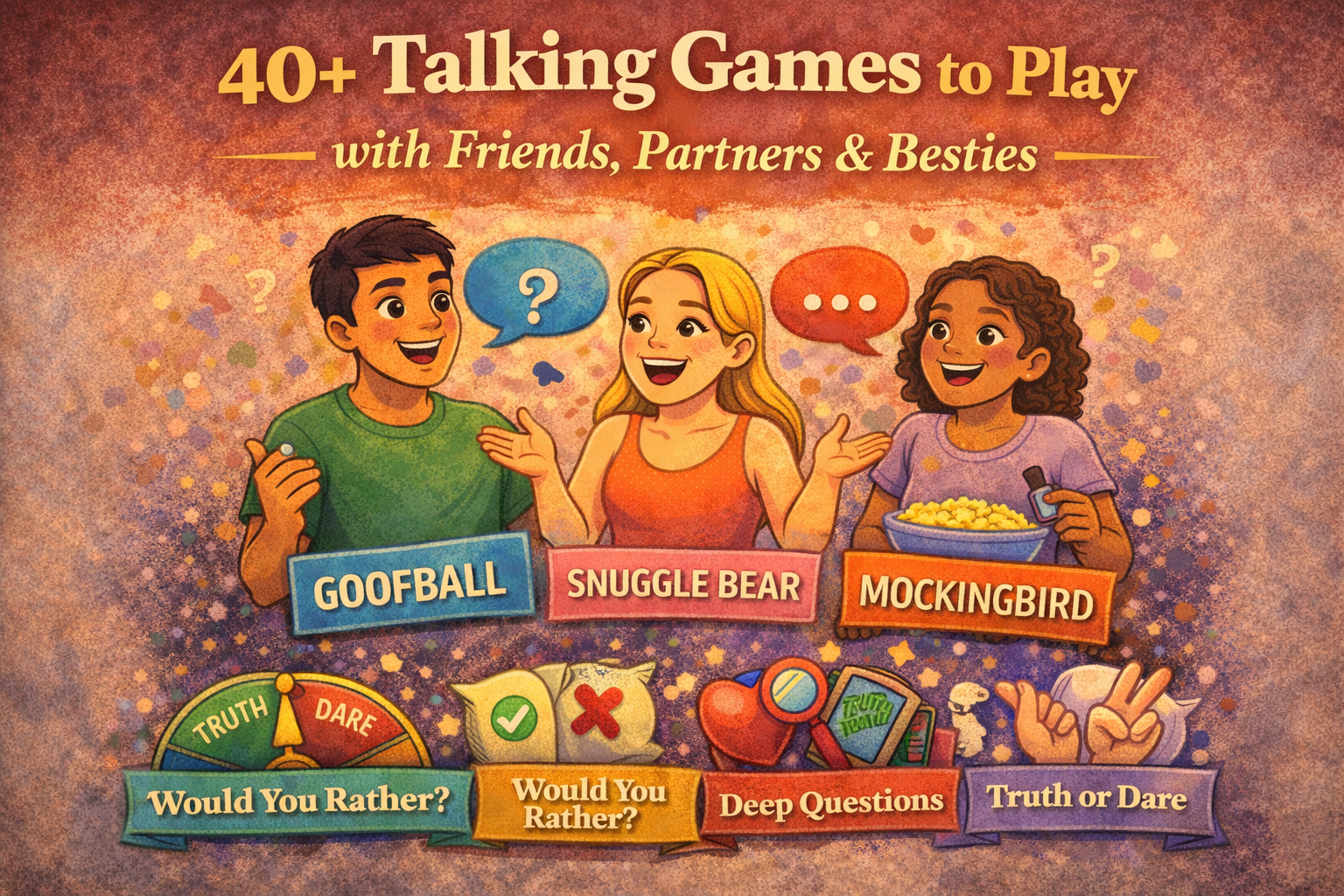
Why Talking Games Are the Secret to Deeper Connections
Let’s be honest: “How are you?” “Good, you?” only gets us so far.
In a world of quick texts and surface-level scrolling, meaningful conversation has become a rare gift. Talking games change that. They create a playful structure that:
✅ Lowers the pressure of “deep talk” by making it feel like a game
✅ Reveals surprising things about people you thought you knew
✅ Builds empathy, laughter, and inside jokes
✅ Works anywhere: car rides, dorm rooms, date nights, group hangs
Best of all? Most require zero supplies—just curiosity and a willingness to listen.
That’s why we’ve curated 40+ original talking games designed to transform small talk into real connection. Whether you’re bonding with a new friend, reigniting spark with a partner, or just looking to laugh until your cheeks hurt, there’s a game here for you.
Pro Tip: Keep it judgment-free. The goal is connection, not interrogation.
🧊 8 Icebreaker Talking Games (Perfect for New Friends or Groups)
Break the awkwardness and spark instant connection:
1. Two Truths and a Dream
How to play: Share two true facts about yourself + one dream or aspiration (not a lie!). Others guess which is the dream.
Why it works: Reveals hopes without pressure; sparks supportive conversation.
Supplies: None
2. Would You Rather: Connection Edition
How to play: Ask thoughtful dilemmas: “Would you rather know how you’ll die or when?” Move to opposite sides of the room to show your choice.
Sample questions:
- “Would you rather have more time or more money?”
- “Would you rather be deeply loved by few or lightly liked by many?”
Supplies: List of questions (or use a free app)
3. The 3-Question Speed Round
How to play: Pair up. Each person asks the other 3 quick questions (pre-agreed or spontaneous). Rotate partners every 5 minutes.
Sample starters: “What’s something you’re proud of this week?” “What’s a small joy you’ve noticed lately?”
Why it works: Fast, low-stakes, and builds multiple micro-connections.
Supplies: Timer (optional)
4. Story Starter Chain
How to play: One person starts a story with “Once upon a time…” Each player adds one sentence. Watch where it goes!
Why it works: Encourages creativity, listening, and collaborative fun.
Pro Tip: Record the story on your phone to share later.
Supplies: None
👉 20 of the most common hug types
5. The Compliment Circle
How to play: Sit in a circle. Each person gives a genuine, specific compliment to the person on their right.
Example: “I love how you always notice when someone needs help.”
Why it works: Builds warmth, safety, and positive energy instantly.
Supplies: None
6. Emoji Life Update
How to play: Describe your week using only 3 emojis. Others guess what happened.
Example: 🎉😴☕ = “Partied hard, crashed hard, needed coffee to survive.”
Why it works: Fun, visual, and reveals personality through digital-native language.
Supplies: Phones (optional) or paper
7. The “Never Have I Ever” Conversation Twist
How to play: Instead of fingers down, anyone who HAS done the experience shares a 30-second story.
Example prompt: “Never have I ever changed my mind about something important.”
Why it works: Turns a classic game into a storytelling opportunity.
Supplies: List of thoughtful prompts
8. Rose, Thorn, Bud
How to play: Share:
🌹 Rose = a highlight
🌵 Thorn = a challenge
🌱 Bud = something you’re looking forward to
Why it works: Balanced, reflective, and works for any group size or age.
Supplies: None
👉 Take the Rice Purity Test now and see where you stand!
💬 10 Deep Conversation Games (For Meaningful Moments)
Go beyond small talk with these thoughtful prompts:
9. The Question Jar
How to play: Write deep questions on slips of paper. Take turns drawing and answering.
Sample questions:
- “What’s a belief you’ve changed your mind about?”
- “What does ‘home’ mean to you?”
- “When did you feel most proud of yourself?”
Why it works: Removes pressure to “come up with” deep topics on the spot.
Supplies: Paper, pen, jar
👉 50+ original, adult-tested party games
10. The “Why?” Ladder
How to play: Start with a simple statement (“I love coffee”). The next person asks “Why?” Keep going 3-5 layers deep.
Example:
“I love coffee.” → “Why?” → “It helps me focus.” → “Why is focus important to you?”
Why it works: Reveals values, motivations, and hidden layers.
Supplies: None
11. Life Soundtrack
How to play: Share 3 songs that represent your past, present, and future. Explain why.
Why it works: Music unlocks emotion and memory in unique ways.
Supplies: Optional: speaker to play snippets
12. The Gratitude Exchange
How to play: Take turns sharing: “One thing I’m grateful for about you is…”
Why it works: Builds appreciation, strengthens bonds, and ends on a high note.
Supplies: None
13. Future Self Letters
How to play: Write a short note to your future self. Share one thing you’re hoping for.
Why it works: Encourages reflection, hope, and vulnerability in a safe way.
Supplies: Paper, pens
14. The “What If” Game
How to play: Ask imaginative, values-revealing questions:
- “What if you could master one skill overnight?”
- “What if money didn’t matter—what would you do with your time?”
Why it works: Sparks creativity while revealing priorities.
Supplies: List of prompts
👉 250+ original, laugh-out-loud funny nicknames
15. Memory Lane Mapping
How to play: Draw a simple timeline of your life. Mark 3 pivotal moments. Share one with the group.
Why it works: Visual + verbal storytelling creates deeper understanding.
Supplies: Paper, pens (optional)
16. The Values Sort
How to play: List 10 values (kindness, adventure, security, etc.). Pick your top 3. Share why.
Why it works: Clarifies what matters most—and helps others understand your choices.
Supplies: Printed values list or whiteboard
17. The Apology Practice
How to play: Share a time you struggled to apologize. What made it hard? What did you learn?
Why it works: Builds emotional intelligence and normalizes growth.
Supplies: None
18. The “Unsung Hero” Spotlight
How to play: Share someone who positively impacted your life (not famous—just meaningful). Tell their story.
Why it works: Cultivates gratitude and reveals what you admire in others.
Supplies: None
👉 25+ original, age-tested slumber party games
😂 8 Funny & Silly Talking Games (For Laughs & Lightheartedness)
Keep the vibe playful with these hilarious prompts:
19. Absurd Advice Column
How to play: Pose a ridiculous problem: “My cat keeps judging my life choices. Help!” Others give earnest, over-the-top advice.
Why it works: Silly premises + serious delivery = comedy gold.
Supplies: List of absurd scenarios
20. Celebrity Dinner Party
How to play: Name 3 celebrities (alive, dead, fictional) you’d invite to dinner. Explain your guest list.
Why it works: Reveals interests, humor, and values through pop culture.
Supplies: None
21. The “Worst Superpower” Game
How to play: Invent the most useless superpower: “I can turn invisible… but only when no one’s looking.”
Why it works: Creativity + humor = instant bonding.
Supplies: None
22. Fake Product Pitch
How to play: Invent a ridiculous product (“Self-Stirring Soup”) and pitch it like a Shark Tank contestant.
Why it works: Encourages improv, teamwork, and playful competition.
Supplies: None
23. The “Most Likely To” Roast (Affectionate)
How to play: “Who in this group is most likely to…” finish with something silly: “…adopt 10 rescue llamas?”
Why it works: Playful teasing that celebrates personalities.
Supplies: List of prompts
24. Time Travel Tour Guide
How to play: You’re a tour guide in any era. Describe one “must-see” attraction (real or made up).
Example: “Welcome to 1999! Don’t miss the Y2K Panic Experience!”
Why it works: Historical humor + creative storytelling.
Supplies: None
25. The “Explain It Like I’m 5” Challenge
How to play: Pick a complex topic (quantum physics, taxes, your job). Explain it in simple, funny terms.
Why it works: Forces clarity, humor, and humility.
Supplies: List of topics
👉 50+ original, student-tested college party themes
26. Alternate Universe Me
How to play: Describe your life if one small choice had gone differently: “If I’d taken that art class…”
Why it works: Playful “what if” thinking reveals hopes and regrets without heaviness.
Supplies: None
💕 7 Relationship-Building Games for Couples & Besties
Deepen your closest connections with these intimate prompts:
27. The Appreciation Avalanche
How to play: Take turns sharing: “One thing I appreciate about you that you might not know I notice is…”
Why it works: Specific, unexpected appreciation feels deeply seen.
Supplies: None
28. Memory Remix
How to play: Share a favorite memory you share. Then, the other person adds one detail they remember that you forgot.
Why it works: Celebrates shared history and shows how perspectives differ.
Supplies: None
29. The “Small Things” Inventory
How to play: List 5 tiny things your person does that make you smile. Share them.
Example: “The way you hum when you’re cooking.”
Why it works: Highlights everyday love that often goes unspoken.
Supplies: None
👉 150+ original, hand-crafted Truth or Dare questions
30. Future Fantasy Builder
How to play: Describe your ideal day together 5 years from now. Be specific: where you are, what you’re doing, how you feel.
Why it works: Aligns hopes and builds shared vision.
Supplies: None
31. The “Repair Attempt” Practice
How to play: Share a recent minor conflict. Practice saying: “What I really needed in that moment was…”
Why it works: Builds communication skills for real-life disagreements.
Supplies: None
32. Love Language Detective
How to play: Guess your person’s top love language (words, time, gifts, acts, touch). Then ask: “What’s one way I could show love that would feel extra meaningful?”
Why it works: Turns theory into actionable care.
Supplies: Optional: love languages quiz
33. The “Unspoken Rule” Reveal
How to play: Share one unspoken rule you have in relationships: “I need 10 minutes of quiet after work before chatting.”
Why it works: Prevents misunderstandings and builds mutual respect.
Supplies: None
👉 How to improve your social life in college
🎲 7 Quick & Easy No-Prep Talking Games (Play Anywhere)
Zero setup, maximum connection:
34. One Word Story
How to play: Build a story one word at a time. Go fast!
Example: “Once… upon… a… time… a… pickle…”
Why it works: Silly, fast, and requires zero preparation.
Supplies: None
35. The 60-Second Check-In
How to play: Set a timer. Each person shares their current mood + one word why.
Example: “Hopeful… because… sunrise.”
Why it works: Quick emotional pulse-check that builds awareness.
Supplies: Phone timer
36. Alphabet Association
How to play: Go through the alphabet. For each letter, name something you’re grateful for, excited about, or curious about.
Example: A = Adventure, B = Breakfast, C = Connection…
Why it works: Structured but flexible; great for car rides.
Supplies: None
37. The “High-Low” Game
How to play: Share your high point and low point of the day/week. Keep it brief.
Why it works: Simple, balanced, and builds empathy.
Supplies: None
38. Question Tennis
How to play: Ask a question. The answerer responds, then immediately asks a new question back. Keep the rally going!
Why it works: Builds conversational rhythm and curiosity.
Supplies: None
39. The “Three Words” Challenge
How to play: Describe your day, your mood, or your person using exactly three words.
Example: “Chaotic. Caffeinated. Content.”
Why it works: Forces creativity and concise expression.
Supplies: None
40. The “Listen & Repeat” Game
How to play: One person shares a short thought. The other repeats it back in their own words before responding.
Why it works: Builds active listening skills and reduces misunderstandings.
Supplies: None
👉 Ultimate collection of 100+ original Never Have I Ever questions
🌟 Bonus: 5 Themed Talking Games (For Special Occasions)
41. New Year Reflection Round
Prompts: “What’s one thing you’re releasing this year?” “What’s a small goal you’re excited about?”
Best for: January gatherings, birthday reflections
42. Travel Dreaming Game
Prompts: “If you could teleport anywhere right now, where would you go?” “What’s a travel memory that changed you?”
Best for: Pre-trip excitement or wanderlust nights
43. Creative Collaboration Challenge
How to play: Co-create a story, poem, or business idea in 10 minutes. Share your masterpiece.
Best for: Creative friends, team-building
44. Gratitude Time Capsule
How to play: Share one thing you’re grateful for today. Record it (voice memo or written) to revisit in 6 months.
Best for: Milestone moments, end-of-year gatherings
45. The “Ask Me Anything” Safe Zone
How to play: Set ground rules: no judgment, right to pass. Take turns asking curious, kind questions.
Best for: Deepening trust in established relationships
👉 What does your Rice Purity score says about your personality?
🎯 Pro Tips for Hosting Talking Games That Actually Connect
✅ Set the Tone First
- Start with: “This is a judgment-free zone. Pass anytime. Listen to understand, not to respond.”
- Model vulnerability: Share first to give others permission.
✅ Match the Game to the Moment
- New group? Start with icebreakers (#1-8)
- Deepening a bond? Try relationship games (#27-33)
- Need laughs? Go silly (#19-26)
- Short on time? Use no-prep games (#34-40)
✅ Keep It Flowing
- Limit answers to 1-2 minutes for larger groups
- Use a “talking object” (a pen, stone) to signal whose turn it is
- Have 2-3 backup games ready if energy shifts
✅ Prioritize Psychological Safety
- Never force sharing. “Pass” is always a valid answer.
- Redirect if teasing crosses into discomfort.
- End on a positive note: “One word for how you’re feeling now?”
Conclusion: Conversation Is a Gift—Play Is the Wrapper
Talking games aren’t about perfect answers or clever responses. They’re about creating space—for laughter, for vulnerability, for the quiet moments when someone says, “Me too.”
You don’t need fancy supplies or flawless facilitation. You just need curiosity, kindness, and the willingness to listen.
So pick one game from this list. Try it tonight. Text your bestie: “Wanna play Two Truths and a Dream?” Ask your partner: “What’s one small thing I do that makes you smile?”
Because the best conversations don’t just happen. They’re invited. And sometimes, all it takes is a game to open the door.
Frequently Asked Questions
How do I get shy people to participate?
Start with low-pressure games (emoji updates, one-word answers). Pair shy folks with a buddy. Never put anyone on the spot.
What if a question feels too personal?
Always offer a “pass” option. Have lighter backup questions ready. Remind everyone: “Share only what feels comfortable.”
Can talking games work for virtual hangouts?
Absolutely! Use video calls, screen-sharing for prompts, and breakout rooms for pairs. Games like “Two Truths and a Dream” translate perfectly.
How long should a talking game session last?
20-45 minutes is ideal. Leave room for organic conversation afterward. Quality > quantity.
What if the conversation gets heavy?
Acknowledge the feeling: “That’s real. Thank you for sharing.” Then pivot to a lighter game or offer a break. Have grounding resources ready if needed.