
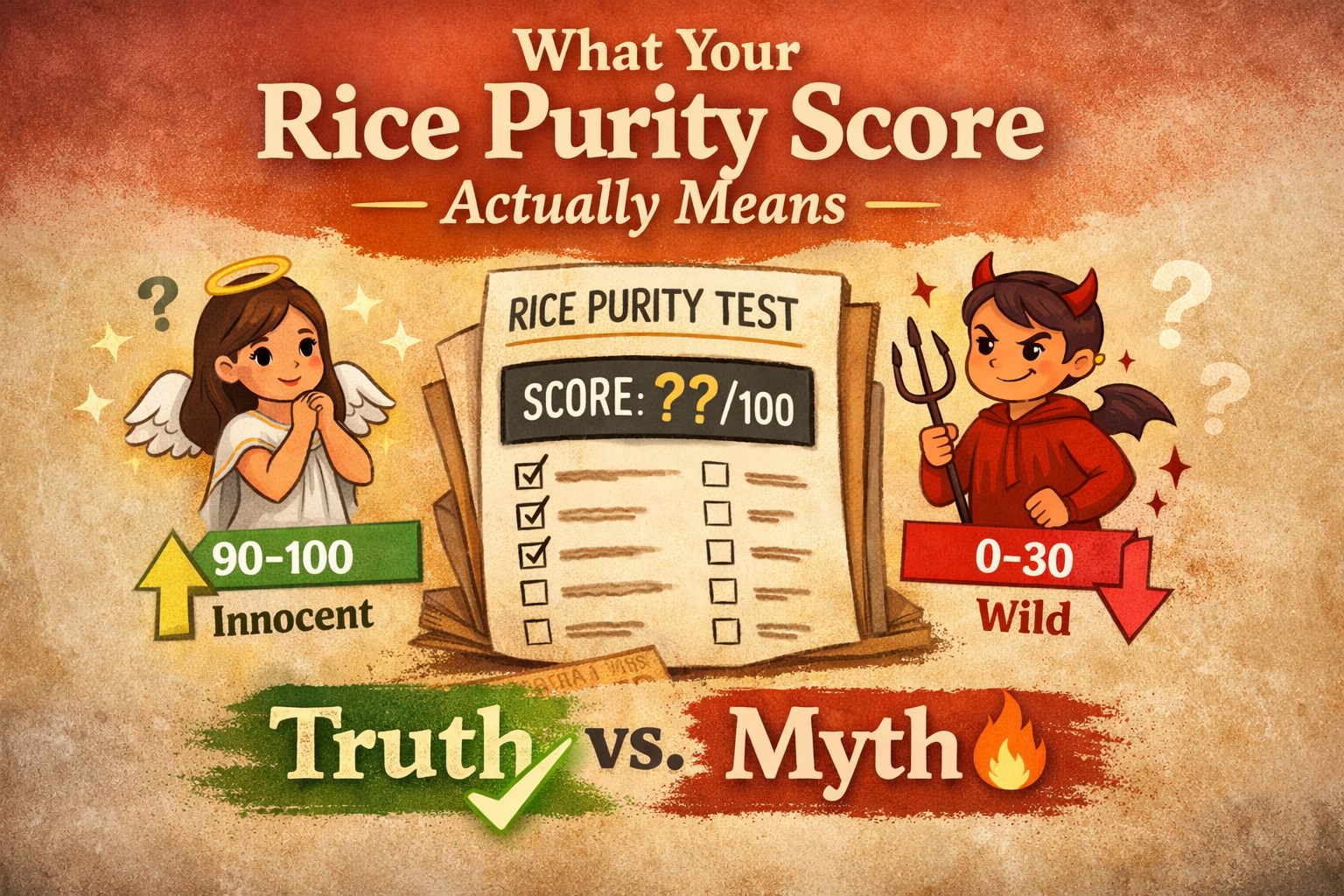
If you’ve ever clicked a link labeled “Take the Rice Purity Test,” you’ve likely experienced the same ritual: 100 rapid-fire yes-or-no questions, a starting score of 100, and a final two-digit number that friends instantly judge, joke about, or overanalyze. But beneath the viral trends and group-chat comparisons lies a lingering question: What does your Rice Purity score actually say about your personality?
The short answer? Almost nothing, psychologically speaking.
The longer answer reveals how internet culture, human curiosity, and outdated moral framing collided to create one of the most misunderstood digital quizzes of the past decade.
Let’s separate fact from fiction, decode the science behind experience tracking, and explore why your score is a cultural mirror—not a personality blueprint.
The Truth Behind the Rice Purity Test: Origins vs. Internet Myth
Contrary to TikTok lore, the Rice Purity Test wasn’t designed as a personality assessment. It originated at Rice University in Houston as a lighthearted orientation icebreaker, likely taking its modern 100-question form in the 1980s. Paper copies were handed out to incoming students to spark conversation, ease social anxiety, and normalize the awkward transition to college life.
The word “purity” in the title is a historical relic, echoing early-20th-century moral frameworks that equated life experience with lost innocence. Today, the test lives primarily on unofficial websites, shared through Discord servers, Instagram stories, and late-night study breaks. Its survival isn’t due to accuracy—it’s due to accessibility, anonymity, and the human craving for quick self-categorization.
👉 20 of the most common hug types
How the Score Actually Works (And Why the Math Is Misleading)
The scoring system is intentionally simple:
- Start at 100
- Subtract one point for every “yes”
- Final score lands between 0–100
Questions span casual milestones (“Stayed out past 2 AM”) to intimate or legally gray experiences. There’s no weighting, no contextual follow-up, and no verification. The test treats all “yes” answers identically, regardless of intent, consent, cultural background, or emotional weight.
From a psychometric standpoint, this design fails basic reliability and validity standards. Scores shift based on memory gaps, question interpretation, and willingness to self-disclose. Two people with identical scores may have lived entirely different lives. The number measures reported exposure, not character.
👉 50+ original, adult-tested party games
Decoding the Ranges: Cultural Labels vs. Psychological Reality
Over years of campus circulation and algorithmic amplification, informal score brackets emerged. These are social shortcuts, not clinical categories:
| Score Range | Internet Label | What It Actually Reflects |
| 90–100 | “The Cautious Idealist” | Fewer risk-taking or socially transgressive experiences. May reflect structured upbringings, personal boundaries, or delayed independence. |
| 70–89 | “The Typical Explorer” | Moderate exposure to college-age social experiences. Aligns with statistical norms for traditional undergraduates. |
| 50–69 | “The Social Adventurer” | Higher engagement with parties, dating, or rule-bending. Often correlates with extroverted circles or earlier autonomy. |
| 30–49 | “The Experienced Nomad” | Significant exposure to nightlife, substances, or unconventional choices. May reflect urban upbringing, gap years, or high sensation-seeking. |
| 0–29 | “The Unfiltered Veteran” | Extensive life experience across multiple domains. Rare in traditional college samples; more common among non-traditional students or older test-takers. |
These labels persist because humans love categorization. But they ignore a critical truth: experience is not personality. A high score doesn’t mean someone is reckless; a low score doesn’t mean someone is rigid. Both numbers simply map past choices, not core traits.
👉 40+ original talking games for friends
Why Your Rice Purity Score Isn’t a Personality Test (The Science Explained)
Personality psychology relies on validated frameworks like the Big Five (OCEAN): Openness, Conscientiousness, Extraversion, Agreeableness, and Neuroticism. These traits measure how you consistently think, feel, and behave—not what you’ve done.
The Rice Purity Test measures neither traits nor tendencies. It measures retrospective self-reporting of specific behaviors. Research shows only weak, highly contextual correlations between certain experiences and personality facets:
- Sensation-seeking (linked to Openness/Extraversion) may loosely align with lower scores, but motivation matters. Planned exploration ≠ impulsivity.
- Conscientiousness often predicts rule-following, which could raise scores, yet conscientious individuals also engage in deliberate, consent-driven experimentation.
- Cultural, socioeconomic, and gender norms heavily dictate which experiences are accessible, encouraged, or stigmatized, making cross-person score comparisons statistically meaningless.
Your Rice Purity score personality correlation is a myth. It’s a behavioral tally, not a psychological profile.
👉 250+ original, laugh-out-loud funny nicknames
The Real Psychology Behind Why We Obsess Over the Score
If the test lacks scientific validity, why does it dominate group chats and social feeds? Several cognitive and social drivers explain its staying power:
- Narrative Identity Formation: Humans construct self-understanding through storytelling. The quiz offers a quantifiable anchor to reflect on personal boundaries, growth, and life transitions.
- Low-Stakes Vulnerability: Sharing a score feels like controlled disclosure. It triggers reciprocal sharing, reduces social friction, and creates instant “me too” bonding moments.
- Social Comparison Theory: We naturally evaluate ourselves against peers. The test gamifies experience, turning private histories into public metrics. Fun until it fuels insecurity.
- Confirmation Bias: Once you see your number, you interpret it through your existing self-concept. A “94” becomes “proof” of responsibility; a “51” becomes “evidence” of wildness. The score doesn’t define you; your mindset defines the score.
👉 25+ original, age-tested slumber party games
Limitations You Should Know Before Sharing Your Number
Before treating your result as a personality badge, consider these structural blind spots:
- Zero Psychometric Validation: No peer-reviewed studies confirm reliability, validity, or predictive power.
- Moralistic Framing: The “purity” label implies experience equals moral decline, ignoring consent, personal growth, and behavioral neutrality.
- Cultural & Demographic Gaps: Questions assume Western, college-aged, heteronormative experiences. They overlook trauma, disability, religious boundaries, LGBTQ+ realities, and global norms.
- Context Erasure: A “yes” reveals nothing about motivation, safety, or emotional impact. Coerced, accidental, and deeply meaningful experiences are scored identically.
- Reductionist Risk: Flattening multifaceted identity into a two-digit number encourages labeling, not understanding.
👉 50+ original, student-tested college party themes
How to Use the Test as a Tool for Self-Reflection (Not Comparison)
The Rice Purity test isn’t useless—it’s just misapplied. Shift the focus from judging to understanding:
✅ Ask reflective questions: Why did I answer yes or no? What boundaries have I set? Which experiences align with my values?
✅ Normalize diverse timelines: Life experience isn’t a race. Early exploration and later discovery are equally valid.
✅ Separate behavior from identity: What you’ve done doesn’t dictate who you are. Choices can change; core values evolve through reflection.
✅ Use it conversationally: Replace “What’s your score?” with “What experiences shaped your boundaries lately?”
When approached mindfully, the quiz becomes a catalyst for growth—not a label for comparison.
👉 150+ original, hand-crafted Truth or Dare questions
Final Takeaway: Your Score Is a Story, Not a Diagnosis
What your Rice Purity score says about your personality is simple: almost nothing. What it does reveal is how you’ve navigated curiosity, boundaries, and social environments so far. It’s a cultural artifact, a conversation starter, and a reminder that human experience refuses to be reduced to a two-digit metric.
If you take the test, treat it as a mirror, not a label. Let it prompt reflection, not comparison. Because personality isn’t deducted point by point—it’s built through awareness, intention, and the courage to grow beyond any number.
👉 How to improve your social life in college
👉 Ultimate collection of 100+ original Never Have I Ever questions
Frequently Asked Questions
What does a high Rice Purity score mean for personality?
It typically indicates fewer socially transgressive or risk-taking experiences, but it doesn’t measure traits like empathy, discipline, or emotional intelligence.
Is the Rice Purity test accurate for judging character?
No. It’s a self-reported behavioral checklist with no psychometric validation. It measures past exposure, not moral or psychological traits.
Can your Rice Purity score change over time?
Yes. It’s a snapshot of experiences up to the moment you take it. As life unfolds, new answers shift the number.
Why do colleges still reference the Rice Purity test?
Some use it as a lighthearted icebreaker. Modern educators often reframe it to discuss consent, peer pressure, and personal boundaries rather than ranking experience.
Should I worry if my score is low or high?
No. Scores reflect accessibility, curiosity, cultural context, and personal choice—not worth, stability, or future success.