
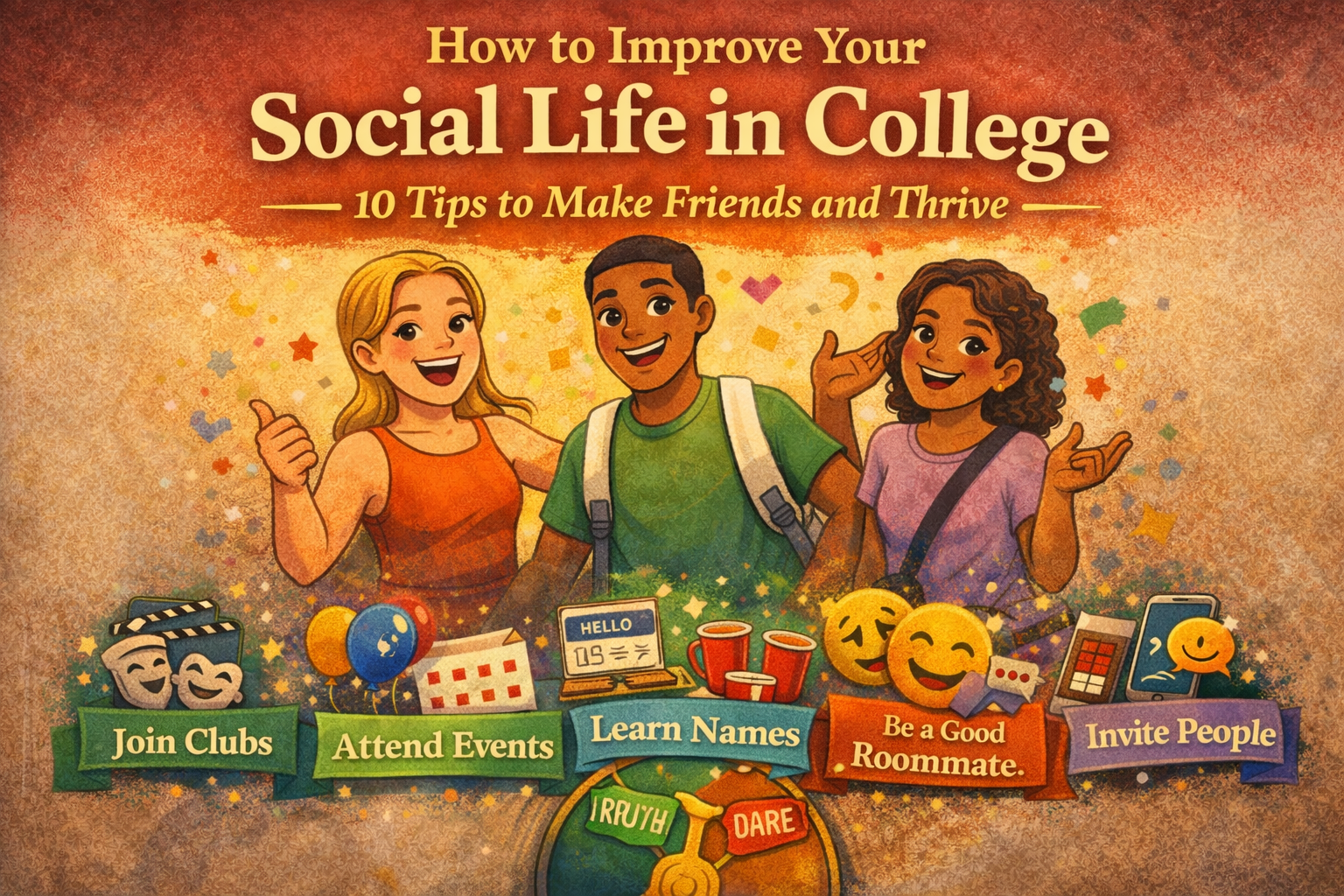
Why Your College Social Life Matters (More Than You Think)
Let’s be honest: college isn’t just about grades. It’s about growth, discovery, and connection. Research consistently shows that students with strong social connections report higher academic performance, better mental health, and greater overall satisfaction with their college experience.
But if you’re feeling isolated, overwhelmed, or unsure where to start—you’re not alone. Transitioning to college means leaving behind familiar faces and navigating a sea of new people, expectations, and social norms. It’s normal to feel awkward, uncertain, or even lonely at first.
The good news? Social skills are just that—skills. And like any skill, they can be learned, practiced, and strengthened.
That’s why we’ve created this practical, compassionate guide with 10 actionable tips to help you improve your social life in college. No forced extroversion. No fake personas. Just real strategies to help you connect authentically, build confidence, and thrive.
🎯 Tip #1: Start Small—Micro-Connections Build Momentum
You don’t need to become the life of the party overnight. Social confidence builds through small, consistent interactions.
Try this:
- Smile and say “hi” to someone in your dorm hallway
- Ask a classmate, “What did you think of that lecture?”
- Compliment someone’s notebook, sticker, or shirt: “Cool design—where’d you get it?”
Why it works: These micro-moments reduce social anxiety by normalizing interaction. They also create “connection hooks”—tiny openings that can grow into deeper conversations later.
Pro Tip: Keep a “connection journal” for one week. Note every small interaction you initiate. You’ll be surprised how quickly your comfort zone expands.
👉 20 of the most common hug types
🎯 Tip #2: Join One Thing—Just One—that Genuinely Interests You
Forget joining five clubs to “look busy.” Depth beats breadth when building real friendships.
How to choose wisely:
- Pick an activity you’d enjoy even if no one else showed up
- Look for groups with regular meetings (consistency = connection)
- Prioritize smaller groups (10-20 people) for easier conversation
Great starter options:
- Academic clubs related to your major
- Hobby-based groups (photography, hiking, board games)
- Volunteer organizations with hands-on projects
- Cultural or identity-based affinity groups
Why it works: Shared interests create instant common ground. When you’re focused on an activity, conversation flows more naturally—no awkward small talk required.
👉 50+ original, adult-tested party games
🎯 Tip #3: Master the “Follow-Up Question” Technique
Great conversations aren’t about being interesting—they’re about being interested.
The formula:
- Listen to their answer
- Pick one detail to explore deeper
- Ask an open-ended follow-up
Example:
Them: “I’m from Portland.”
You: “Oh cool! What’s something you miss most about home?”
(Instead of just: “Nice.”)
Why it works: Follow-up questions signal genuine curiosity, which makes people feel seen and valued. This builds trust faster than any clever joke or impressive story.
Pro Tip: Keep 3 go-to follow-ups in your back pocket:
- “What got you interested in that?”
- “What’s that been like for you?”
- “What would you recommend for someone new to that?”
👉 Take the Rice Purity Test now and see where you stand!
🎯 Tip #4: Create “Low-Stakes” Social Invitations
Asking someone to “hang out” can feel huge. Make it easier—for both of you—with low-pressure invites.
Try these scripts:
- “I’m grabbing coffee before class—want to walk together?”
- “A few of us are studying at the library later if you want to join.”
- “I’m checking out that new campus event Thursday—care to come with?”
Why it works: Specific, time-bound, activity-focused invitations reduce ambiguity and social pressure. They also give the other person an easy “out” if they’re not available—no awkwardness.
Bonus: These mini-invites often lead to bigger plans naturally, without the stress of “planning a whole thing.”
👉 40+ original talking games for friends
🎯 Tip #5: Embrace the “Regulars” Strategy
Friendships thrive on repetition. Psychologists call this the “mere exposure effect”—we tend to like people more the more we see them.
How to apply it:
- Sit in the same spot in class or the dining hall
- Attend the same club meeting weekly
- Visit the campus gym or coffee shop at consistent times
Why it works: Familiarity breeds comfort. When you become a “regular,” conversations start more easily, inside jokes develop, and connections deepen organically.
Pro Tip: Pair this with Tip #1—small greetings + consistent presence = powerful combo.
👉 250+ original, laugh-out-loud funny nicknames
🎯 Tip #6: Practice “Vulnerability Lite”
Deep friendships require authenticity—but you don’t need to overshare on day one.
Start with “vulnerability lite”:
- “I was actually pretty nervous about this class.”
- “I’m still figuring out my schedule—any tips?”
- “Honestly, I’m a little lost. Have you been here before?”
Why it works: Small, relatable admissions humanize you and invite reciprocity. When you show a little imperfection, others feel safer doing the same.
Avoid: Trauma-dumping or heavy topics too early. Save deeper sharing for when trust is established.
👉 25+ original, age-tested slumber party games
🎯 Tip #7: Leverage “Transition Moments” for Connection
College is full of natural social openings—if you know where to look.
Prime connection windows:
- Before/after class (arrive 5 minutes early, linger 2 minutes after)
- Moving into dorms or during orientation week
- Group project kickoffs or study sessions
- Campus events with built-in mingling (festivals, fairs, workshops)
Why it works: These moments have built-in conversation starters and shared context. Everyone’s in the same boat, which lowers social barriers.
Pro Tip: Prepare one open-ended question for transition moments:
- “What brought you to this event?”
- “What’s your favorite thing about this class so far?”
- “Any recommendations for [campus resource]?”
👉 50+ original, student-tested college party themes
🎯 Tip #8: Reframe Rejection as Redirection
Not every interaction will click—and that’s okay. Social rejection feels personal, but it’s rarely about you.
Healthy reframes:
- “They’re busy” instead of “They don’t like me”
- “Different vibes” instead of “I’m unlikable”
- “Not the right moment” instead of “I messed up”
Why it works: This mindset protects your confidence and keeps you open to future connections. Resilience is a social superpower.
Pro Tip: After any interaction that doesn’t go as hoped, ask: “What’s one thing I learned?” Focus on growth, not judgment.
👉 150+ original, hand-crafted Truth or Dare questions
🎯 Tip #9: Build a “Social Toolkit” for Anxiety
If social situations spike your anxiety, prepare practical coping strategies—not just positive thinking.
Your toolkit might include:
- A grounding technique (5-4-3-2-1 sensory exercise)
- A pre-event ritual (deep breaths, power pose, favorite song)
- An exit strategy (“I need to grab water—be right back”)
- A post-event recharge plan (quiet time, journaling, walk)
Why it works: Preparation reduces uncertainty, which reduces anxiety. Having tools in place lets you engage more fully because you know you can handle discomfort.
Pro Tip: Practice your toolkit before high-stakes events. Muscle memory beats last-minute panic.
👉 Ultimate collection of 100+ original Never Have I Ever questions
🎯 Tip #10: Prioritize Quality Over Quantity
You don’t need 50 friends. You need 2-3 people who truly “get” you.
Signs of quality connections:
- You feel energized, not drained, after hanging out
- You can be your authentic self without editing
- They show up for you during tough times
- Conversations flow easily, even in silence
Why it works: Deep, supportive friendships buffer stress, boost self-esteem, and create a sense of belonging—key predictors of college success and well-being.
Pro Tip: Invest time in nurturing 1-2 promising connections rather than spreading yourself thin trying to meet everyone.
👉 What does your Rice Purity score says about your personality?
🌟 Bonus: What to Do If You’re Starting From Zero
Feeling like everyone else already has their crew? You’re not behind—you’re just beginning.
Your 30-day reset plan:
- Week 1: Focus on micro-connections (Tip #1) + join one group (Tip #2)
- Week 2: Practice follow-up questions (Tip #3) + send 2 low-stakes invites (Tip #4)
- Week 3: Lean into transition moments (Tip #7) + practice vulnerability lite (Tip #6)
- Week 4: Reflect on quality connections (Tip #10) + reinforce one budding friendship
Remember: Social growth isn’t linear. Some days will feel easy; others will feel hard. Progress > perfection.
Conclusion: Your Social Life Is a Practice, Not a Performance
Improving your social life in college isn’t about becoming someone else. It’s about showing up as your authentic self, practicing connection with kindness, and trusting that the right people will resonate with your energy.
You don’t need to be the loudest, funniest, or most popular person in the room. You just need to be present, curious, and consistent.
Start with one tip. Try one conversation. Send one invite. Small steps, repeated, create momentum. And momentum creates connection.
Your people are out there. They’re just waiting for you to say hello.
Frequently Asked Questions
How long does it take to make real friends in college?
Research suggests it takes about 50 hours of time together to move from acquaintance to casual friend, and 200+ hours to become close friends. Focus on consistency, not speed.
What if I’m an introvert?
Introverts often thrive with deeper, one-on-one connections. Prioritize quality interactions over large groups. Recharge alone when needed—it’s self-care, not avoidance.
How do I handle social anxiety in college?
Start small (Tip #1), prepare coping tools (Tip #9), and consider campus counseling resources. Many colleges offer free workshops on social confidence and anxiety management.
Is it normal to feel lonely in college?
Extremely. A 2023 study found that over 60% of college students reported feeling lonely sometimes. You’re not broken—you’re human. Reach out; others feel the same.
How do I balance social life and academics?
Schedule social time like you schedule study time. Even 30 minutes of intentional connection can boost mood and focus. Quality > quantity applies to time management too.